
|
Pediatric Occupational, Physical, ABA/Behavioral, Feeding, Speech, and Language Therapies Main Clinic: 931-372-2567 1445 East 10th Street Cookeville, TN 38501 Email: [email protected] HIPAA Secure Email: [email protected] Fax: (931) 372-2572 ABA Clinic: 931-201-9534 400 Dubois Road Cookeville, TN 38501 Email: [email protected] Please call today to get started! Most insurances accepted!     |
|
| Who needs therapy? | SE HABLA ESPAÑOL |
Sensory Integration Therapy
The Neurology of Sensory
Sensory Processing Disorders Making the Connection: The Brain and Sensory Input
Since the "Era of the Brain" neuroscientists and health care professionals alike have been discovering new information that has opened new doors into the treatment of sensory processing disorders. It is important to understand the connection between basic neural science and sensory processing in order to comprehend the great need for "ordered," not disordered sensory processing for the brain to function properly and learn.
Individuals with severe sensory processing problems usually function at a brain stem level in which primitive instincts for survival and protection are met only, with limited higher cortical learning taking place (see on the home page Feeding the Brain Pyramid).
Sensory processing problems may come from not having "physical sense of self" (touch and proprioception) which leads to a compromised body system that is "in pieces" so that the brain and body is working on keeping self together (brain stem: survival and protection) and is NOT ready for higher cortical functioning until basic subcortical needs are met.
Treatment that begins with primitive reflex integration and sensory integration theory are vital to helping these children overcome their issues.
At Center of Development we use a get "READY BRAIN" approach to all our therapy sessions. We start sessions with the 3 power sensations, individualized for each child's neurological needs, so that the last half of the session their brain and body is "READY" to learn!
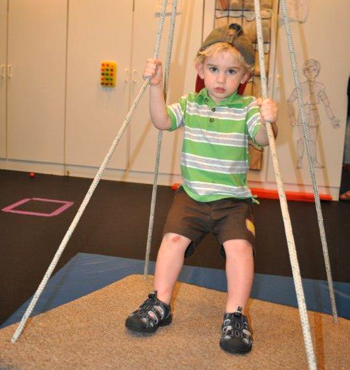
1. Vestibular Sensations: Sets the arousal level to an optimum level to get a calming or arousing response. Most powerful and longest lasting sensation (typically 4-8 hours after 15 minutes on a swing hung from a single point in a linear direction). Vestibular input is a very strong brain stem sensation which is best if done first and followed by proprioception before a cortical task so that the brain stem can take care of and focus on ANS functioning and the cortex can register more information.
2. Proprioception: 9x's rule: For individuals with hypotonia it takes 9 times the effort to get enough tone and to a ready state to even begin to corticalize the information being taken in by muscles and joint receptors. 1 ½ to 2 hour latent affect keeps effects like the sensations are still present.
-
Proprioceptive input causes a release of Serotonin: which is the master regulator chemical in the cortex
-
Serotonin and Dopamine levels increase with proprioception
-
The brain can't get too much serotonin
-
Joint input breaks up dopamine to prevent hyperactivity and over processing of information resulting in a neutral state
-
Sets the firing level for all other neurotransmitters
-
If released suddenly in large amounts brain responds with endorphins "emotional highs" such as a runner's high or that feeling after a great workout!
-
self-injury causes release of serotonin (this is why children bite, pinch, hit, head bang, etc.)
-
Joint and muscle activities release Brain Derived Nerve Growth Factor- a huge "miracle grow" for the brain to help children and adults retain learned information longer, to help them with short and long term memory, and to help them recall later!
When serotonin decreases and norepinephrine increases you will see aggression which often results in the individual SEEKING proprioceptive and deep touch input (holding down, firm grip, etc.) which enhances serotonin levels back to a calming level. Thus, this can cause a terrible cycle of acting out, getting deep touch through punishment, then they get their "fix"-- a release of serotonin to decrease aggression.
Our goal is to establish a healthy SENSORY DIET plan for that child, so that they can get the neuro-transmitters released naturally throughout their day, which will decrease negative seeking behaviors and increase positive skills!
3. Tactile: Deep touch is always better than light touch to result in a calming and organizing input, instead of protective or avoidance response.
-
Deep touch: therapuetic brushing by a trained OT, massage, hand hugs, weighted pressure, swimming, compression clothing, weighted blankets/vests, etc. (calming due to release of brain chemicals, parasympathetic response)
-
Light touch: this is the system that causes you stress when a fly lands on your skin, being brushed lightly in a crowd, alerting and arousing brain chemicals, sympathetic flight or fright response, aggression, avoidance of touch, hyperactivity may come from an overactive light touch system.
-
Deep Massage or Pressure Touch(brushing of skin): Increases Dopamine (Pleasure chemical, activity, helps us stay emotionally neutral and balanced), Nerve Growth Factor Release (fertilizer for neuron growth which creates cortical pathways and more efficient processing), and a Parasympathetic Response (relaxed, neutral, homeostatic state).
Some neurological points to remember:
-
The reticular formation is responsible for sensory modulation ( remaining in a calm and relaxed state) which is enhanced by vestibular input and proprioception.
-
The limbic structures MMOVE us: Motivation, Memory, Olfaction, Viscera, Emotion and these structures are enhanced best by Deep Pressure Touch.
-
Self injurious behaviors are almost always a sure indicator of Sensory Defensiveness!
-
Self stimulation and "shutdown" are almost always a sure indicator of a Sensory Defensiveness or a Modulation problem!
-
You have to treat sensory disorders beginning with Sensory Defensiveness through therapeutic brushing or deep pressure regime, with joint compressions done every 90-120 minutes followed by a sensory diet routine in their everyday life, then once primitive reflexes and sensory modulation issues are under control you can work on integration of the senses.
We all use sensory calming techniques in our world, many people can be observed "self regulating" or calming themselves in a classroom or work setting such as these behaviors:
-
fidgeting with pencil
-
rocking feet
-
rocking in a chair
-
squirming in seat
-
nail biting
-
smoking or eating, chewing gum, oral calmers
-
twirling hair
-
tapping feet or hands on table
-
doodling
-
biting lips
-
leaning heavily onto table
-
getting up to move around during breaks
-
going for walks
-
exercising
-
extreme sports (sensory cravers)
Joint and Muscle Input Proprioception
Vestibular Input: Movement and Balance
Site empowered by
WebOnTheFly
