
|
Pediatric Occupational, Physical, ABA/Behavioral, Feeding, Speech, and Language Therapies Main Clinic: 931-372-2567 1445 East 10th Street Cookeville, TN 38501 Email: [email protected] HIPAA Secure Email: [email protected] Fax: (931) 372-2572 ABA Clinic: 931-201-9534 400 Dubois Road Cookeville, TN 38501 Email: [email protected] Please call today to get started! Most insurances accepted!     |
|
| Who needs therapy? | SE HABLA ESPAÑOL |
Hypotonia ( Low Muscle Tone) General Recommendations
Low muscle tone can cause motor skills to be tiring and difficult. Experts have said that doing an activity with low muscle tone is like doing it 9x's. So writing their name one time, is like a writing it 9 times. Jumping 10 times is like jumping 90 times.
The good news is, therapeutic procedures in OT and PT can help tremendously!
The following are therapeutic procedures we use to increase the joint receptors (proprioceptive system) to fire quicker and be more "awake", most of these activities are actually toys and equipment that can be used daily in the home so they will naturally practice in their play time the skills they need to work on!
I try to make the recommendations as "functional" or as part of a daily routine as possible for your busy schedule!
By setting up a home based "therapy room" the child will naturally begin to do therapy activities on their own.
1. Vestibular input: it is best to swing at least two times daily for 15 minutes each time. The vestibular (movement) system affects the proprioceptive (joint and muscle) system directly. Disc swings require a lot of muscle strength to "hold on" and can be great for short periods of time. Adding a bungy cord system or using swings with bungee systems can add a great "bounce" to the swing to increase more muscle tone.
Gentle spinning as the child can tolerate with a rotational device added to the swing will increase tone. Super Spinner is a great brand found on amazon along with rotational devices.
Try doing games and play that includes rolling, hanging/climbing ladders, gentle somersaults, and playground play.
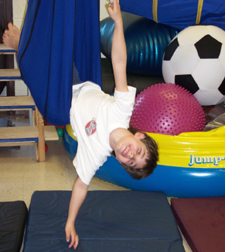
One of the best options other than swinging is rebounders! Jumping on a trampoline, jumpolene, or inflatable is a fabulous option to work on increasing muscle strength and muscle tone.
Jumping is also a sensory calming activity and fits in your child's need for aerobic exercise daily!
All of the jumping, rolling, catching themselves in falling, flipping, changing head positions and muscle activity is fabulous input to their vestibular and proprioceptive systems and will help increase muscle tone, strength, endurance, and overall motor development.
2. Proprioceptive (joints and muscles): give a lot of opportunities to continue to weight bear on hands to help build up palmer arches and strengthen web space (muscles between thumb and first finger).
Home ideas for weight bearing on hands: crawl through tunnel, cut out holes on the sides of boxes and make crawl through houses, throw down all couch pillows and extra pillows on the floor and "chase" each other creeping on hands and knees, make tents for playhouses over tables and chairs to crawl around, air mattress in safe place to jump and crawl on, and again trampolines or jumpolene inflatables.
Daily wheelbarrow walking is fabulous- start with walking on hands off the therapy ball, and work up to walking around without support of ball and then try a modified push-up on hands with small ball under their legs.
Weighted med balls are found at exercise sections of Walmart and sports stores. These are fabulous for building up strength in their web space of their hands for improved fine motor coordination and strength. Med balls also help to build shoudler strength when used with a basketball goal or higher than head height goals. If you can't get a basketball goal, then just use a laundry basket or bucket with bottom cut out, but placing it above shoulder level height is the best option! This will help strengthen the core trunk muscles, upper body, and hand and arm strength greatly as well, and is a lot of fun for children.
Vibration, massagers, and bumble balls are also great for low muscle tone, any kind of vibration helps stimulate tone and wakes up the joint receptors making them more alert and ready to move!
With these types of toys and activities, you are providing play that naturally will stimulate balance, muscle tone, strength, coordination, and core trunk stability, which in turn will give them foundational skills for harder tasks such as cutting, writing, fastener skills and academics!
3. Tactile play: make sure there are many opportunities for touch play in many different textures.
This includes edible foods, puddings, jellos, kid's safe shaving cream (Fun Foam), and other safe textures.
Make homemade slimes and putty! Great to promote hand strength to squeeze, pinch, roll, etc.
Practice cutting and knife skills using playdough kitchen tools.
You can combine texture play with fine motor work such as making circles, lines, crosses and X in these textures while in the bath tub using the side of the tub as your incline board!
Another safe place to get messy in the summer (or in the winter in the garage) is in a small kiddie pool!
Homemade textures such as mixing flour and water or starch and water give some good "resistance or pull" when making shapes or letters, this helps them "feel" the movement more, making a stronger motor memory!
4. Fine motor strengthening: the key to good fine motor skills are stable core muscles, strong muscles, and good vestibular and proprioceptive feedback.
Therefore, all of the gross motor and sensory motor tasks aforementioned, are stepping stones to good fine motor control.
A child that avoids handwriting, reading, fastener skills or other fine motor tasks, is usually avoiding because they have poor vestibular, proprioceptive, tactile or visual sensory processing.
An OT evaluation can assess all of these skills and therapy can help them gain the sensory processing needed to complete these tasks with ease!
Here are a few quick ideas on how to naturally help gain better fine motor control:
*Incline work: put anything to color, paint, or puzzles on an incline such as using incline boards, easels, tape paper to a mirror to color on, or play with removable stickers on the windows. Removable cling on decors with their favorite character on the windows and doors are always a good way to promote pincer grasp, wrist extension, and fun fine motor activity. Chalk walls are fabulous in their rooms!
*Another favorite for younger ones is the Leap Frog Fridge Magnets with the farm animal puzzle, and the ABC 123 magnets.
*Placing their favorite pictures of themselves and family members, pets on soft pliable fridge magnets are also a great way to get the wrist extension and pincer grasp promoted in natural play setting.
*Use magnetic clips to clip up Color Wonder paper, and only have color wonder markers available so that they can color on that paper and make a mark only on that paper while sitting or standing at the fridge or dish washer, or even in the laundry room as most magnets work on washers and dryers as well!
*Play with play dough and modeling clay (more like theraputty used in therapy with a firmer texture)often, helping them to squeeze it, roll it, and pinch it. Hide small objects in the play dough for them to find by using fingertips, pinching, and pulling.
*Put snacks in a small opening cup to force more finger isolation (one finger) and fingertips to reach in and try to get them out. Put cheerios into a "fine motor can" just a simple plastic container with a hole cut out of the lid, this way they have to invert the container, pour things out, then use a pincer grasp to put them back in.
*Keep felt pipe cleaners handy in the kitchen, then place anything that has a hole in the middle of it on it for snack or mealtimes such as cheerios or other cereals. This promotes lacing and beading exercises but they work on it while you are getting meals ready!
*Make a scarf bottle, put pretty colored scarves or pieces of brightly colored materials in a tall creamer or even a coke 16 ounce bottle, cut a hole in the lid if needed, close the lid on the creamer bottle, and have them pinch and pull them out with their fingertips and thumb pinching to pull it out, they will inevitably want to then push it back in, which is another great activity.
5. Self Help skills: this takes a lot of patience and is more time consuming because you do have to help more in this area!
*Dressing: have plenty of dress up clothes in a box or laundry hamper that they can practice dressing up with easy to pull on clothes during play time. Pulling on and off little dance skirts and ballet skirts are often the best way to learn how to pull up and down your pants! For boys, animal dress up clothes can be found at Halloween as well, cowboy dress up, fireman dress up, etc.
*Shoes and socks: practice is the key, letting them practice on their own in a safe environment, sitting them against the wall helps a lot, or in a large chair to give them the trunk support.
Backward chaining is the best method, this means you do as much of the first couple of steps such as putting the socks on most of the way, then they pull up at the end to finish the task. This way they feel successful that they were the to finish the task! Then you gradually do less and less at the first steps, as they gain more skills.
Putting a red dot with a permanent marker for the right shoe and a green dot for the left inside the sole of the shoe, or other techniques help them remember which one goes on which foot too to decrease the frustration. R for right and L for left inside the shoe works. When they learn the letter L, show them that left makes 'L" the correct way.
*Zippers: play bags that have large zippers and storing toys in bags or old backpacks are great way to help them learn zippers. If the zipper is too small for them to pinch and pull, then use a binder loop used for hole punched papers found at office max or walmart in the office supply to attach a large circle metal loop onto their zippers helps this made easier until they gain the skills needed to pinch.
Until they have the pinch strength to pinch the zipper you can attach zipper pulls (Amazon has cute ones) or just simply attach key ring circles found at Walmart to zippers.
*Tooth brushing: often a fun child's vibrating spinbrush/toothbrush is best.
Tom's organic tooth pastes are great tasting and fluoride free they can swallow a lot and it won't hurt them!
Using a vibrating toothbrush with a spin head will also help stimulate oral muscle tone and can be given with a cup of water prior to meals to help get the oral motor muscles ready for chewing! Keep one at the sink but also another in the car, and one in the kitchen to give at opportune times.
Site empowered by
WebOnTheFly
