Center of Development
Pediatric Occupational, Physical, Behavior,
Nutrition, and Speech & Language Therapies
1080 Neal Street, Suite 300
Cookeville, TN 38501
Phone: (931) 372-2567, Toll-Free: (877) 372-2567
Fax: (931) 372-2572

Home > *General Information, Links, and Resources > Sensory Integration Dysfunction & Dyspraxia

Sensory Integration Dysfunction & Dyspraxia

Question: What is Sensory Integration Dysfunction (DSI) and how can it be treated?


The Condition


What is Sensory Integration Dysfunction?


Dysfunction in Sensory Integration (DSI) is a problem in processing sensations which causes difficulties in daily life. DSI is a complex neurological disorder, manifested by difficulty detecting, modulating, discriminating or integrating sensation adaptively. DSI causes children to process sensation from the environment or from their bodies in an inaccurate way, resulting in "sensory seeking" or "sensory avoiding" patterns or "dyspraxia," a motor planning problem.


What does DSI look like?


DSI and Sensory Seeking


These children have nervous systems that do not always process that sensory input is "coming in" to the brain. They are under-responsive to sensation. As a result, they seek out more intense or longer duration sensory experiences.


Some behaviors that can be observed are:


  • Hyper-activity as they seek more and more movement input

  • Unawareness of touch or pain, or touching others too often or too hard (may seem aggressive)

  • Engaging in unsafe behaviors, such as climbing too high

  • Enjoying sounds that are too loud, such as TV or radio volume

DSI and Sensory Avoiding


These children have nervous systems that feel sensation too easily or too much. They are overly responsive to sensation. As a result, they may have "fight or flight" responses to sensation, a condition called "sensory defensiveness."


Some behaviors that can be observed are:


  • Responding to being touched with aggression or withdrawal

  • Afraid of, or becomes sick with movement and heights

  • Very cautious and unwilling to take risks or try new things

  • Uncomfortable in loud or busy environments such as sports events, malls

  • Very picky eater and/or overly sensitive to food smells

DSI and Dyspraxia


These children are clumsy and awkward. They have particular problems with new motor skills and activities.


Some behaviors that can be observed are:


  • Very poor fine motor skills such as handwriting

  • Very poor gross motor skills such as kicking, catching, throwing balls

  • Difficulty imitating movements such as "Simon Says"

  • Trouble with balance, sequences of movements and bilateral coordination

The Treatment


What is the Treatment for Sensory Integration Dysfunction?


Occupational Therapy (OT) is used to treat Sensory Integration Dysfunction. The goal of OT is to enable children to take part in the normal "occupations" of childhood - such as playing with friends, enjoying school, eating, dressing and sleeping - which are often problems for children with DSI. Each child is provided with an individualized treatment plan. Direct treatment often occurs at a Children's Hospital or in a private practice setting. Therapists sometimes also consult at home or school. Parents are directly involved in treatment sessions so that they can learn more about their child and, together with the therapist, can figure out how to incorporate their family's priorities into treatment.


What does Occupational Therapy look like?


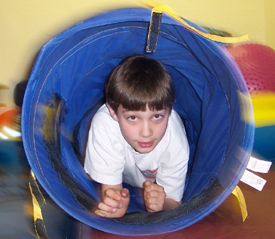
Treatment is fun! It occurs in a large, sensory-enriched gym with lots of swinging, spinning, tactile, visual, auditory and taste opportunities. Using an approach we call "STEP-SI"

(pronounced "step - S - I") with input from parents, we begin to understand how the child perceives sensation and how that affects his/her attention, emotions, motor skills or learning abilities.


We evaluate for each child:


  • Sensory - the responses in each sensory system (e.g. movement, touch, taste, etc.)

  • Task - the need for more vs. less complexity and structure in completing activities

  • Environment - the responses to "enriched' compared to "simple" surroundings

  • Predictability - the necessity for having expected vs. new experiences

  • Self-Monitoring - the child's ability to preview and adjust responses before acting Interactions - the need for less or more intense interactions with others

The overall goals of Occupational Therapy are to improve Social Participation, Self-Esteem, Self-Regulation and Sensory-motor Abilities. In addition, we strive to give parents a toolbox of ideas to use in helping their child become regulated and coordinated. We support parents perception that their child's disability is real, even though it is a "hidden handicap." We also help parents to become strong advocates for their child at school and in other situations.

Related Topics:
Site empowered by
WebOnTheFly